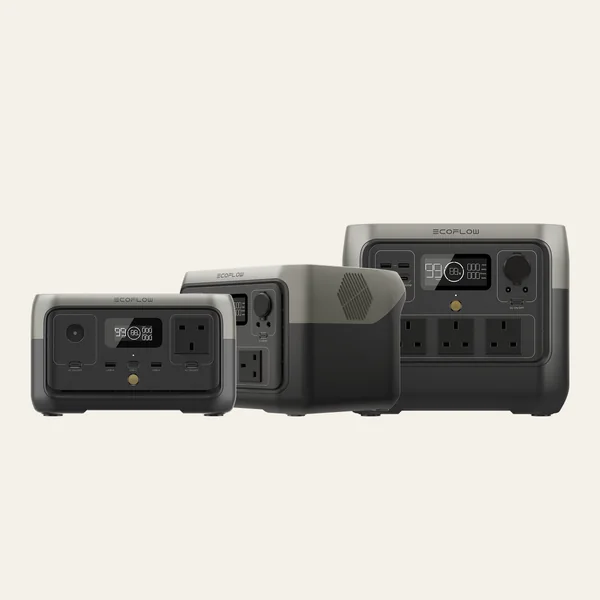
Portable power
Backup power for shops, clinics and offices: how to size a portable UPS
Watts, watt-hours and switchover time explained: how resellers and facility teams choose an EcoFlow power station to keep POS, routers and CCTV running.
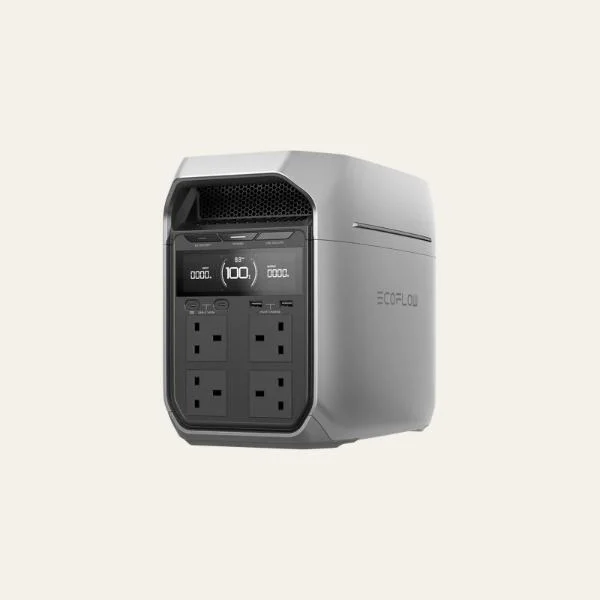
A short outage costs a shop more than the lost minutes. The card terminal goes offline, the router restarts, CCTV stops recording and somebody has to reset the alarm. A portable power station with UPS function bridges that gap without installation work: it sits between the wall socket and the devices and takes over when the grid drops. This guide shows how to choose the right size.
Two numbers that matter: W and Wh
- Output power (W) decides what the unit can run at the same time. Add the rated power of all connected devices; the total must stay below the AC output of the power station.
- Capacity (Wh) decides how long it can run them. Runtime is roughly capacity divided by load.
For planning, we use about 85 % of the rated capacity to allow for conversion losses. That is a rule of thumb, not a manufacturer value.
Switchover time: the UPS function
When the grid fails, the power station switches its outputs to battery. EcoFlow specifies the switchover time for each model:
| Model | Capacity | AC output | UPS switchover |
|---|---|---|---|
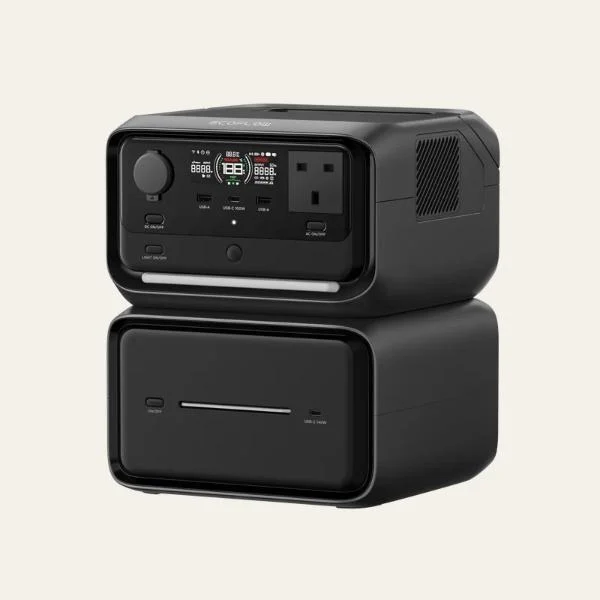
| RIVER 3 Plus | 286 Wh (expandable to 858 Wh) | 600 W | 10 ms |
| DELTA 3 Plus | 1,024 Wh (expandable to 5 kWh) | 1,800 W | under 10 ms |
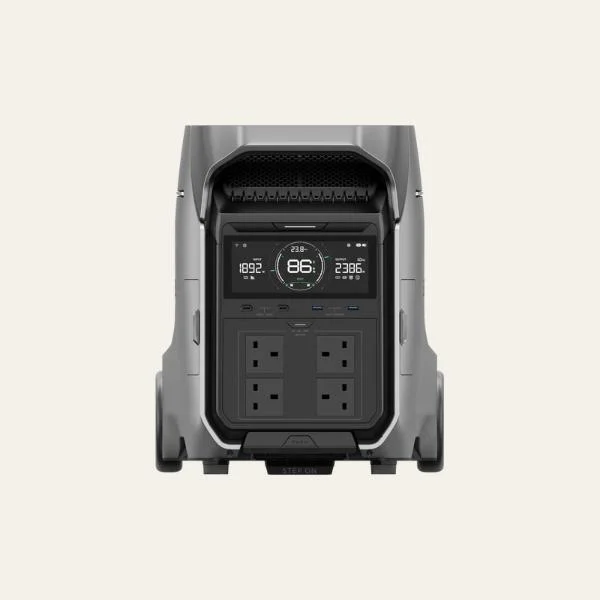
| DELTA Pro 3 | 4,096 Wh (expandable) | 4,000 W | 10 ms |
Routers, card terminals, network video recorders and most office electronics ride through a switchover of this length. For devices with unusual sensitivity, test the setup once before relying on it.
A worked example
A small shop wants to keep the following running during an outage. The values are examples; check the rating plate of each device.
| Device | Example load |
|---|---|
| Router and Wi-Fi access point | 20 W |
| Card terminal and POS PC | 60 W |
| CCTV recorder with four cameras | 50 W |
| Total | 130 W |
With DELTA 3 Plus: 1,024 Wh × 0.85 ÷ 130 W ≈ 6.7 hours. Well within the 1,800 W output, and enough for most outages. With RIVER 3 Plus (286 Wh) the same load would run for about 1.9 hours, which can be enough for a single point of sale.
When to go bigger
- Refrigeration. Display fridges and freezers draw more and need hours of runtime. DELTA Pro 3 with 4 kWh and 4,000 W output covers them; EcoFlow's own reference is about three days for a household refrigerator on one unit.
- Several workstations. Clinics and offices with many PCs, printers and a server cabinet quickly pass the output of a single DELTA 3 Plus.
- Longer outages. All three models can be recharged from solar, and DELTA 3 Plus and DELTA Pro 3 can be expanded with extra batteries.
Set-up tips
- Connect only the loads that matter. Leave kettles, heaters and AC on the grid.
- Put the power station in a ventilated place, not in a closed cabinet.
- Leave the power station plugged in, so the battery is full when the outage comes.
- Test the setup by switching off the supply circuit once.
For resellers and facility managers
All three models are in stock in the UAE. We supply registered resellers, IT integrators and facility management companies with quotations based on volume, and help with load lists for larger rollouts.